

Executive Summary
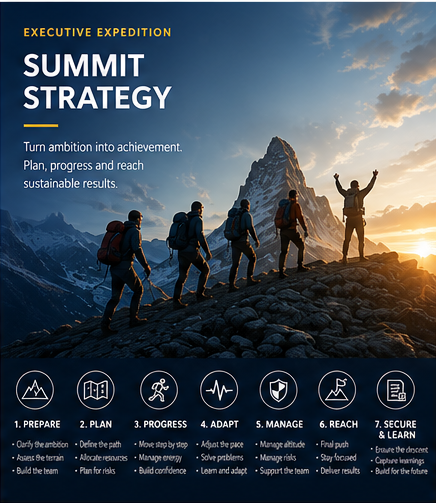
A strategic ambition resembles an ascent. The summit provides direction, but success depends on preparation, route selection, stages, energy management, decision points and adaptation to conditions. The true result is not only reaching the objective: the organisation must return stronger and able to reuse what it learned.
Prepare before departure
Clarify the objective, assess the terrain, build the team and verify skills and resources.
Turn vision into a plan
Break the ascent into stages, define passage criteria, reserves, decision points and fallback scenarios.
Progress with discipline
Move step by step, make progress visible, monitor energy and avoid confusing intense activity with real advancement.
Adapt to conditions
Weather, physical condition and terrain change. Strategy must likewise adjust to markets, resources and new information without losing its intent.
Descend safely
A transformation is not complete when success is announced. New processes must be stabilised, knowledge transferred and regression prevented.
Celebrate and capitalise
Recognising effort, sharing lessons and embedding learning turns a one-off success into lasting advantage.
Expedition principles
Prepare
Define the objective and verify resources.
Plan
Choose the route and decision points.
Progress
Move through measurable stages.
Adapt
Adjust pace and plan.
Reach
Achieve the objective with control.
Descend
Stabilise and secure the result.
Capitalise
Convert experience into future capability.
ADWaltiS checklist
- Is the objective clear and realistic?
- What are the critical stages and decisions?
- What reserves of time, energy and budget do we have?
- Which signals will trigger adaptation or retreat?
- How will results be secured after the objective is reached?
- How will learning be shared?