

Executive Summary
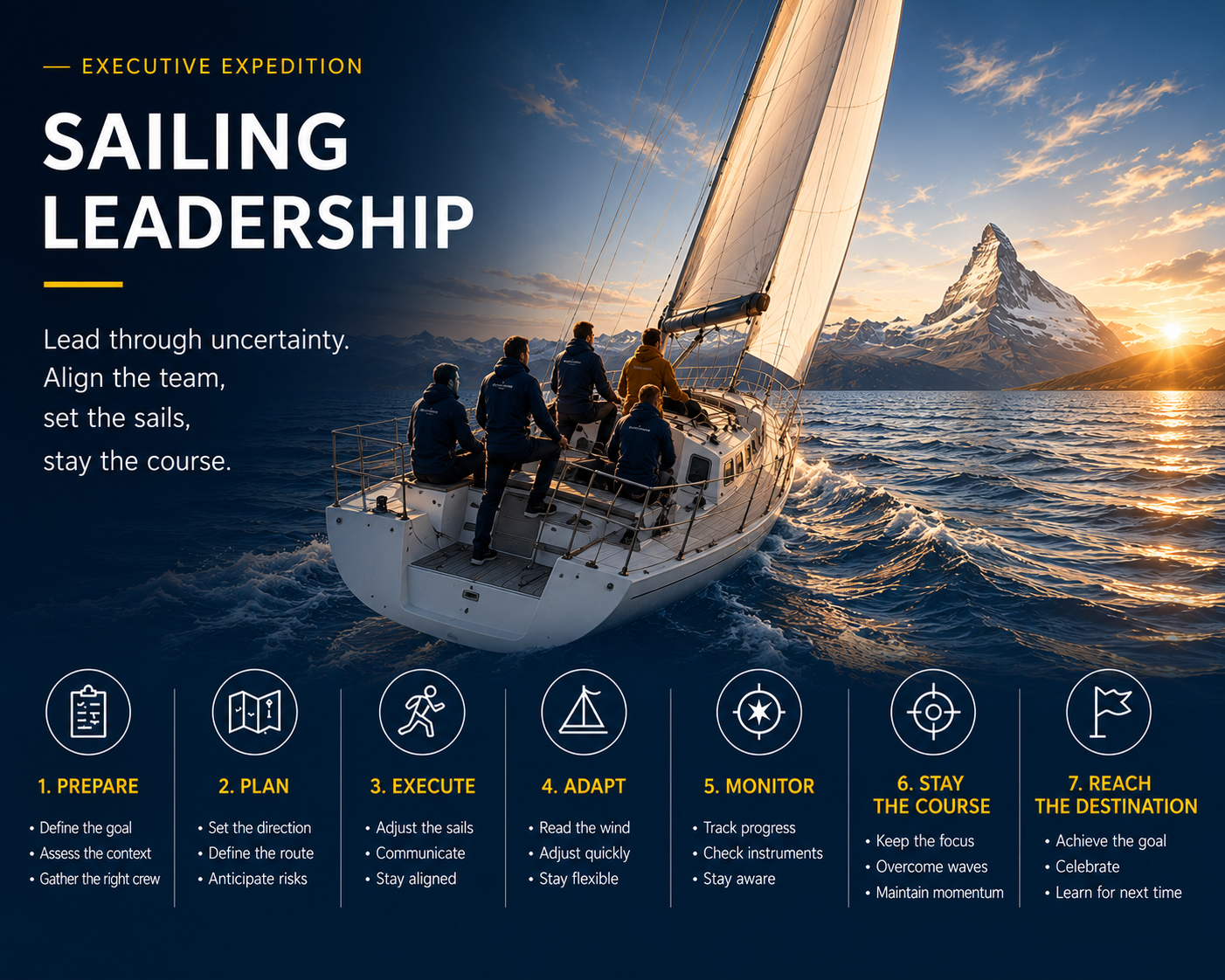
Leadership in uncertainty is not about pretending to control the environment. It is about keeping a clear direction while adapting how the organisation moves forward. Like on a sailing boat, performance depends on reading conditions, coordinating the crew, making sound decisions and continuously trimming the sails.
Read the environment before acting
Markets, technology, customers and regulation create favourable, adverse or shifting winds. Effective leaders observe signals, separate facts from impressions and avoid confusing speed with haste.
Align the crew
A shared destination is not enough if roles, priorities and responsibilities remain unclear. Alignment turns individual capabilities into collective performance.
Adjust the sails
A robust strategy is not rigid. It defines the destination and decision criteria, while allowing the means to change when conditions shift.
Preserve resources
An organisation should not consume all its energy to maintain temporary speed. It must protect skills, time, cash and learning capacity for the long term.
Turn uncertainty into options
The earlier a change is detected, the more options remain. Leadership creates choices before constraints impose a single response.
Expedition principles
Observe
Read real signals and constraints.
Align
Share the course, priorities and roles.
Decide
Choose with the information available.
Adjust
Adapt the means without losing direction.
Accelerate
Use favourable winds without exhausting the crew.
Learn
Turn every manoeuvre into learning.
ADWaltiS checklist
- Is the course understood by everyone?
- Which external signals could change the trajectory?
- Are roles and responsibilities explicit?
- Which resources must be preserved?
- When should we adjust or change course?
- How will we learn from this stage?